Cisco 7921 Usb Drivers For Mac
- Samsung Usb Drivers For Mac
- Cisco Usb Cable Windows 10 Driver
- Sony Hdd Dcr-sr300 Usb Drivers For Mac Book
- Cisco Wireless Usb Drivers Ae1200
- Cisco 7921 Usb Drivers For Mac
The Cisco Unified Wireless IP Phone 7921G gets its time and date when it registers with Cisco Unified CallManager. Power cycle the phone to reset the time or date. The time shows in either 12 hour or 24 hour format.
Table Of Contents
Using the Cisco Unified Wireless IP Phone 7921G Web Pages This chapter describes how to set up your PC to configure a Cisco Unified Wireless IP Phone 7921G by using a USB connector and how to remotely access a configured phone over the WLAN. Cisco Unified Wireless IP Phone 7921G Administration Guide for Cisco Unified Communications Manager OL-15164-01 Chapter 4 Using the Cisco Unified Wireless IP Phone 7921G Web Pages Using the USB Connection for Initial Phone Configuration Installing the USB Drivers To install the drivers on your PC, follow these steps: Procedure. Home » Cisco Unified Wireless IP Phone 7921G Use the links on this page to download the latest version of Cisco Unified Wireless IP Phone 7921G drivers. All drivers available for download have been scanned by antivirus program. If you power off the Cisco Unified Wireless IP Phone 7921G, 7925G, 7925G-EX, and 7926G with the USB cable connected and then power it on again, the USB connection might fail. To enable the USB connection, unplug the USB cable from the phone and then plug it back in. Cisco Unified Wireless IP Phone 7921G Administration Guide for Cisco Unified CallManager Release 4.1, 4.2, 5.0 OL-10802-02 Note When using BAT to add Cisco Unified Wireless IP Phones, use the default setting.
Using the Cisco Unified Wireless IP Phone 7921G Web Pages
You can use the Cisco Unified Wireless IP Phone 7921G web pages to setup and configure these settings for the phone:
•Network Profiles that include WLAN settings
•USB port settings
•Trace settings
This chapter describes how to set up your PC to initially configure a Cisco Unified Wireless IP Phone 7921G through a USB connection and how to remotely access a configured phone over the WLAN.
After you have initially configured phones, you can make adjustments to network settings on the phone by using the Settings menu and Network Profile menu options. For more information, see Chapter 5, 'Configuring Settings on the Cisco Unified Wireless IP Phone 7921G.'
This chapter includes these topics:
•Using the USB Connection for Initial Phone Configuration
•Updating Phones Remotely
•Configuring Network Profiles
•Configuring USB Settings
•Configuring Trace Settings
•Using System Settings
Using the USB Connection for Initial Phone Configuration
To setup new phones for deployment to users, use your PC to enter the initial configuration for the wireless network settings and network profiles. To save time during initial deployment, you can create a standard network profile template and export it to several phones. For more information, see the 'Backup Settings for Phone Configuration' section.
See these sections for information about initial phone configuration:
•Setting Up Your PC to Configure the Cisco Unified Wireless IP Phone 7921G
•Accessing the Phone Web Page
•Setting Configuration Privileges for the Phone Web Page
•Accessing the Configuration Web Page for a Phone
Setting Up Your PC to Configure the Cisco Unified Wireless IP Phone 7921G
Before you can configure phones using the USB connection, you must install drivers and set up the USB ports on the phone and PC.
To interface with the phone and web pages using the USB cable, the PC must run one of these operating systems:
•Windows 2000 Professional
•Windows XP
These sections provide information about setting up your PC:
•Installing the USB Drivers
•Configuring the USB LAN on the PC
•Using the USB Cable to Configure Phones
Installing the USB Drivers
To install the drivers on your PC, follow these steps:
Procedure
Step 1 Download the installation package and 'read me' file for the USB drivers from this location:
Note Before proceeding, review the 'read me' file for specific instructions for your PC operating system.
Step 2 Double-click on the USB-Install-7921.1-0-1.exe file to start the installation program.
Step 3 Follow the prompts in the InstallShield Wizard.
Note If you receive a Hardware Installation warning message stating that the software has not passed Microsoft Windows Logo testing, click Continue.
Step 4 The driver installation is complete when you see the Finished screen. You can close the wizard.
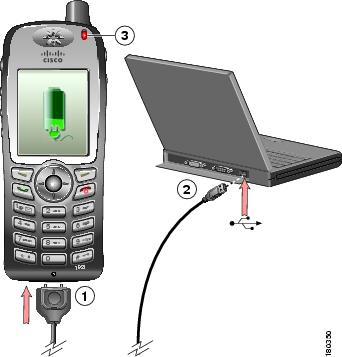
Step 5 Plug the USB cable into the USB port on the PC and into the USB connector on the phone.
The Found New Hardware Wizard dialog opens.
Step 6 To update the new software, click the button next to Yes, this time only and click Next.
Step 7 Click the button next to Install the Software automatically (Recommended).
After 2-3 minutes, the software installs and a message appears on the task bar stating 'Found New Hardware - Software installed and ready to use.'
Step 8 Click Finish when the installation is complete.
The phone briefly displays 'USB Connected' on the status line.
Configuring the USB LAN on the PC
To configure the USB LAN connection on your PC, follow these steps:
Procedure
Step 1 To setup the USB LAN connection, do one of the following:
•For Windows XP—Click Start > Control Panel > Network Connections.
•For Windows 2000—Click Start > Settings > Control Panel > Network and Dial Up Connections.
Step 2 Locate and double-click the new LAN connection to open the Local Area Connection Status window, then click Properties.
Step 3 Scroll to the Internet Protocol (TCP/IP) component and click Properties.
Step 4 In the Internet Protocol (TCP/IP) Properties window, choose Use the following IP address:
Step 5 In the IP address field, enter a static IP address for the PC: 192.168.1. (1-254 -except 100), for example: 192.168.1.11
Note•By default, the Cisco Unified Wireless IP Phone 7921G is configured with 192.168.1.100 so you cannot use this IP address for the PC.
•Make sure to use an IP address that is not in use on any other interface on the PC.
Step 6 Enter the subnet mask: 255.255.255.0
Step 7 Click OK to make the changes.
Related Topics
•Accessing the Phone Web Page
•Setting Configuration Privileges for the Phone Web Page
•Accessing the Configuration Web Page for a Phone
Accessing the Phone Web Page
After setting up the USB interface on the PC, you are ready to use the USB cable connection to the phone.
To access the phone web page, follow these steps:
Procedure
Step 1 Open a Windows browser.
Step 2 In the address field, enter https://192.168.1.100 to locate the wireless IP phone web page.
Note When the Security Alert dialog box displays a notice to accept the Trust Certificate, click Yes or Always to accept the application.
The Summary web page for the phone displays. See Table 4-1 for details about this web page.
Step 3 Use the hyperlinks in the left column of the web page to configure settings for the phones. For information, see these sections:
•Configuring Network Profiles
•Configuring IP Network Settings
•Configuring USB Settings
•Viewing Trace Logs
•Using System Settings
Step 4 After entering the new settings, disconnect the USB cable from the phone. The settings are active immediately.
Step 5 Check that the phone can access the network successfully.
Using the USB Cable to Configure Phones
You are ready to use the USB cable to set up other phones. Before plugging the USB cable into another phone, wait approximately 12-15 seconds for the USB interface on the PC to shut down.
To connect to another phone, follow these steps:
Procedure
Step 1 Plug the USB cable into a Cisco Unified Wireless IP Phone 7921G.
The phone briefly displays 'USB Connected' on the status line.
Step 2 Access the web page for the new phone by following the steps in 'Accessing the Phone Web Page' section.
Related Topics
•Installing the USB Drivers
•Configuring the USB LAN on the PC
•Using the USB Cable to Configure Phones
•Accessing the Phone Web Page
Updating Phones Remotely
You might have to update settings on a Cisco Unified Wireless IP Phone 7921G that is already configured and in use. You can use the wireless LAN to remotely access and configure these phones.
Use these sections for information about remotely updating phones:
•Setting Configuration Privileges for the Phone Web Page
•Accessing the Configuration Web Page for a Phone
Setting Configuration Privileges for the Phone Web Page
To make changes to the phone by using the web page, you must use Cisco Unified CallManager Administration to change Web Access.
To allow configuration privileges, follow these steps:
Procedure
Step 1 Log into Cisco Unified CallManager Administration.
Step 2 Search for the phone in Cisco Unified CallManager by choosing Devices > Phones and enter search information such as the directory number.
Step 3 Open the Phone Configuration page and scroll down to Product Specific Configuration.
Step 4 In the Web Access field, click the drop-down arrow and select Full.
Step 5 Click Update to make the change.
Step 6 You must reset the phone to enable configuration privileges on the web pages for this phone.
Accessing the Configuration Web Page for a Phone
You can access the web page for any Cisco Unified Wireless IP Phone 7921G that is connected to the WLAN. Be sure the phone is powered on and connected.
To access the web page for the Cisco Unified Wireless IP Phone 7921G follow these steps:
Procedure
Step 1 Obtain the IP address of the Cisco Unified Wireless IP Phone 7921G using one of these methods:
•Search for the phone in Cisco Unified CallManager by choosing Devices > Phones. Phones registered with Cisco Unified CallManager display the IP address on the Find and List Phones web page and at the top of the Phone Configuration web page.
•On the Cisco Unified Wireless IP Phone 7921G, press Settings > Device Information > Network Configuration and then scroll to the IP Address option.
Step 2 Open a web browser and enter the following URL, where IP_address is the IP address of the Cisco Unified IP Phone:
https://<IP_address>
Note When the Security Alert dialog box displays a notice to accept the Trust Certificate, click Yes or Always to accept the application.
Step 3 Log in to the web pages with username: admin and enter the password: Cisco for the phone web pages.
The Summary web page for the phone displays. See Table 4-1 for details about this web page.
Step 4 Make changes to configurable pages as needed. For information, see these sections:
•Configuring Network Profiles
•Configuring USB Settings
•Configuring Trace Settings
•Using System Settings
Step 5 Return to the Phone Configuration web page in Cisco Unified CallManager Administration and set the Web Access field back to ReadOnly or Disabled.
Step 6 Reset the phone from Cisco Unified CallManager to disable full access to the web pages.
Be sure to change the Web Access privileges and reset the phone to prevent users from making configuration changes on the phone web pages.
Note If a wireless IP phone was previously registered to Cisco Unified CallManager Release 4.x, and then registers to Cisco Unified CallManager 5.x, the Phone Configuration web page password might be reset to 'Cisco.'
Summary Information Web Page
The Summary Information area on a phone's web page displays device settings and related information for the phone. Table 4-1 describes these items.
Description | |
|---|---|
Phone DN | Directory number assigned to this phone |
Active Network Profile | Name of the profile that the phone is currently using |
SSID | SSID that the phone is currently using |
Access Point | Name of the access point to which the phone is associated |
MAC Address | Media Access Control (MAC) address of the phone |
Network Information | |
IP Address | Internet Protocol (IP) address of the phone |
Subnet Mask | Subnet mask used by the phone |
Default Router | IP address for the default gateway that the phone is using |
TFTP Server | IP address for the Primary Trivial File Transfer Protocol (TFTP) server that the phone is using |
Active CallManager | IP address for the Cisco Unified CallManager server to which the phone is registered |
Directory Number | Primary directory number for the phone |
Related Topics
•Accessing the Phone Web Page
•Configuring Network Profiles
•Configuring USB Settings
•Configuring Trace Settings
•Using System Settings
Configuring Network Profiles
You can configure up to four different profiles for a phone to take advantage of different WLAN environments. You can add names to the profiles and enable one or more of the profiles for the phone to use. The Network Profiles area displays this information about each profile:
•Enabled Profile—A check mark designates an enabled profile
•Name—Lists the name for the profile
•SSID—Lists the SSID used by this profile
•Status—Identifies which profile the phone is using
To display the Network Profiles list, access the web page for the phone as described in the 'Accessing the Phone Web Page' section, and then click the Network Profiles hyperlink.
For more information about configuring network profiles, see these sections:
•Network Profile Settings
•Configuring Wireless Settings in a Network Profile
•Setting the Wireless LAN Security Mode
•Setting the Wireless Security Credentials
•Setting Wireless Encryption
•Configuring IP Network Settings
•Configuring the Alternate TFTP Server
•Configuring Advanced Settings
Network Profile Settings
You can configure the settings for a profile by using this web page area. You can also modify or view configured profiles from this web page area. Table 4-2 describes these items and provides references for more information.
To display Network Profile(1-4) Settings, access the web page for the phone as described in the 'Accessing the Phone Web Page' section, and then click the Profile (1-4) hyperlink.
Description | ||
|---|---|---|
Wireless Settings | ||
Profile Name | Provides a name for the profile to make it easy to identify; up to 63 alphanumeric characters. | |
SSID | Assigns the Service Set Identifier (SSID) to this profile. You must assign the same SSID to the phone that is also assigned to access points in the wireless network. | |
Single Access Point | Determines scanning frequency: True—Minimizes the scanning for APs False—Frequent scanning of all access points within range for best match | |
Call Power Save Mode | Set for the type of power saving mode used in the WLAN. Options are: •U-APSD/PS-Poll •None | |
802.11 Mode | Determines the signal mode or priority for selecting signal modes available in the WLAN. Options are: •802.11 b/g—Use only 2.4 GHz band •802.11a—Use only 5 GHz band •Auto, 802.11b/g preferred over 802.11a (dual band) •Auto, 802.11a preferred over 802.11b/g (dual band) •Auto, signal strength (RSSI)—Use strongest signal in dual band environment | |
Authentication Method | Sets the authentication and encryption methods for this profile: •Open—Open access to APs •Open+WEP—Open access with WEP encryption (requires an encryption key) •Shared+WEP—Shared key authentication with WEP (requires an encryption key) •LEAP—Cisco proprietary authentication and encryption using a RADIUS server (requires a username and password) •EAP-FAST—Authentication and encryption using TLS and RADIUS server (requires a username and password) •Auto (AKM)—Automatic authenticated key management using: –WPA, WPA2 (requires a username and password) –WPA-Pre-shared key, WPA2-Pre-shared key (requires a passphrase/pre-shared key) –CCKM (requires a username and password) | |
Export Security Credentials | Controls whether the wireless security credential data can be exported in the configuration file. •True—Allows exporting the data •False—Blocks exporting the data | |
Wireless Security Credentials | Required for LEAP, EAP-FAST, and Auto (AKM) authentication methods | |
Username | Assigns the network authentication username for this profile | |
Password | Assigns the network authentication password for this profile | |
Sets the Pre-shared key for this profile | ||
Pre-shared Key Type | Determines the key type: Hex or ASCII | |
Pre-shared Key | Identifies the key | |
Wireless Encryption | Required for Open+WEP and Shared+WEP authentication methods | |
Key Type | Determines the encryption key type: Hex or ASCII | |
Encryption Key 1-4 | Identifies the Transmit Key: •Encryption Key character string •Key Size of 40 or 128 characters | |
Obtain IP address and DNS servers automatically | Enables DHCP | |
Use the following IP address and DNS servers | Disables DHCP and uses these static settings: •IP Address •Subnet Mask •Default Router •Primary DNS •Secondary DNS •Domain Name | |
TFTP | ||
Obtain TFTP servers automatically | Determines whether DHCP assigns the TFTP server | |
Use the following TFTP servers | Assigns static TFTP server IP addresses for: •TFTP Server 1 •TFTP Server 2 | |
TSPEC Settings | ||
Minimum PHY Rate | Minimum data rate that outbound traffic uses | |
Surplus Bandwidth | Excess bandwidth beyond application requirements | |
802.11G Power Settings | Enabled—Identifies enabled channels in WLAN to improve scanning for the phone Max Tx Power—Sets the maximum transmit power for the phone | |
802.11A Power Settings | Enabled—Identifies enabled channels in WLAN to improve scanning for the phone Max Tx Power—Sets the maximum transmit power for the phone | |
Note If you uncheck all channels in the 802.11 G Power Settings or 802.11 A Power Settings, the phone will not be able to access the WLAN.
Related Topics
•Accessing the Phone Web Page
•Configuring Wireless Settings in a Network Profile
•Setting the Wireless LAN Security Mode
•Setting the Wireless Security Credentials
•Setting Wireless Encryption
Configuring Wireless Settings in a Network Profile
You must configure these wireless settings in a profile to enable the phone to access the wireless network.
To configure the wireless settings, refer to Table 4-2 and follow these steps:
Procedure
Step 1 Choose the network profile that you want to configure.
Step 2 To give the profile a recognizable name, in the Profile Name field, enter a name up to 63 characters and numbers in length.
Step 3 To identify the SSID that the phone uses to associate with access points, in the SSID field, enter an SSID that is already configured in the WLAN.
Note The SSID is case sensitive; you must enter it exactly as configured in the network.
Step 4 To determine the scanning frequency of the phone, in the Single Access Point field, choose True (less frequent scanning) or False (more frequent scanning).
Step 5 To conserve battery power, in the Call Power Save Mode, choose the type (U-APSD or PS-Poll) and option that is being used in the WLAN.
Step 6 Choose the signal mode or priority of signal modes in the 802.11 Mode field that is used by your WLAN,
Setting the Wireless LAN Security Mode
The Cisco Unified Wireless IP Phone 7921G supports many types of authentication. Authentication methods might require a specific encryption method or you can choose between several encryption methods. When configuring a network profile, you can choose one of these authentication methods:
•Open—Provides access to all access points without WEP Key authentication/encryption.
•Open plus WEP—Provides access to all access points and authentication through the use of one or more WEP Keys at the local access point.
•Shared Key plus WEP—Provides shared key authentication through the use of WEP Keys at the local access point.
•LEAP— Exchanges a username and cryptographically secure password with a RADIUS server for authentication in the network. LEAP is a Cisco proprietary version of EAP.
•EAP-FAST—Exchanges a username and password and with a RADIUS server for authentication in the network.
•Auto(AKM)—Automatic authenticated key management in which the phone selects the AP and type of key management scheme, that can include WPA, WPA2, WPA-Pre-shared key, WPA2-Pre-shared key, or CCKM which uses a wireless domain server (WDS).
The type of authentication and encryption schemes that you are using with your WLAN determine how you set up the authentication, security, and encryption options in the network profiles for the Cisco Unified Wireless IP Phones. Table 4-3 provides a list of supported authentication and encryption schemes that you can configure on the Cisco Unified Wireless IP Phone 7921G.
Wireless Encryption | ||
|---|---|---|
Open | None | None—access to all APs |
Open plus WEP | Static WEP Requires WEP Key | None—access to all APs |
Shared Key plus WEP | Static WEP Requires WEP Key | Uses shared-key with AP |
LEAP (with optional CCKM) | Uses WEP | Requires Username and Password |
EAP-FAST (with optional CCKM) | Uses WEP or TKIP | Requires Username and Password |
Auto (AKM) with WPA (with optional CCKM) | Uses TKIP | Requires Username and Password |
Auto (AKM) with WPA2 | Uses AES | Requires Username and Password |
Auto (AKM) with WPA Pre-Shared Key | Uses TKIP | Requires Passphrase |
Auto (AKM) with WPA2 Pre-Shared Key | Uses AES | Requires Passphrase |
Auto (AKM) with CCKM | Uses TKIP or AES | Requires Username and Password |
Configuring the Authentication Method
To select the Authentication Method for this profile, follow these steps:
Procedure
Step 1 Choose the network profile that you want to configure.
Step 2 In the Authentication Method field, click the drop-down arrow and select one of the following:
•Open
•Open+WEP
•Shared+WEP
•LEAP
•EAP-FAST
•Auto (AKM)
Note Depending on what you selected, you must configure additional options in Wireless Security or Wireless Encryption. See Table 4-3 for more information.
Step 3 Click Save to make the change.
Setting the Wireless Security Credentials
When your network uses EAP-FAST, LEAP, or Auto (AKM) with WPA, WPA2, or CCKM for user authentication, you must configure both the username and a password on the Access Control Server (ACS) and the phone.
Note If you use domains within your network, you must enter the username with the domain name, in this format: domainusername.
For information about setting security credentials, see these topics:
•Configuring the Username and Password
•Configuring the Pre-shared Key
•Setting Wireless Encryption
Configuring the Username and Password
To enter or change the username or password for the network profile, you must use the same username and the same password string that is configured in the RADIUS server. The maximum length of the username or password entry is 32 characters.
To setup the username and password in Wireless Security Credentials, follow these steps:
Procedure
Step 1 Choose the network profile that uses LEAP, EAP-FAST, or Auto (AKM).
Step 2 In the Username field, enter the network username for this profile.
Step 3 In the Password field, enter the network password string for this profile.
Step 4 Click Save to make the change.
Configuring the Pre-shared Key
When using Auto (AKM) with WPA Pre-shared key or WPA2 with Pre-shared key for authentication, you must configure a Passphrase/Pre-shared key in the Wireless Security Credentials area.
Pre-shared Key Formats
The Cisco Unified Wireless IP Phone 7921G supports ASCII and hexadecimal formats. You must use one of these formats when setting up a WPA Pre-shared key:
Hexadecimal
For hexadecimal keys, you must enter 64 hex digits (0-9 and/or A-F); for example, AB123456789CD01234567890EFAB123456789CD01234567890EF3456789C
ASCII
For ASCII keys, you must enter a character string that uses 0-9, A-Z (upper and lower case), including symbols and is from 8 to 63 characters in length; for example, GREG12356789ZXYW
To setup a Pre-shared key in the Wireless Credentials area, follow these steps:
Procedure
Step 1 Choose the network profile that uses Auto (AKM) to enable the WPA Pre-shared key or WPA2 Pre-shared key.
Step 2 In the Key Type area, choose one of these character formats:
•Hex
•ASCII
Step 3 Enter an ASCII string or Hex digits in the Passphrase/Pre-shared key field. See 'Pre-shared Key Formats' section.
Step 4 Click Save to make the change.
Setting Wireless Encryption
If your wireless network uses WEP encryption, and you have set the Authentication Method as Open + WEP or Shared Key + WEP, you must enter an ASCII or hexadecimal WEP Key.
The WEP Keys for the phone must match the WEP Keys assigned to the access point. Cisco Unified Wireless IP Phone 7921G and Cisco Aironet Access Points support both 40-bit and 128-bit encryption keys.
WEP Key Formats
You must use one of these formats when setting up a WEP key:
Hexadecimal
For hexadecimal keys, you can use one of the following key sizes:
•40-bit—You must enter a 10-digit encryption key string that uses the hex digits (0-9 and/or A-F); or example, ABCD123456.
•128-bit—You must enter a 26-digit encryption key string that uses the hex digits (0-9 and/or A-F); or example, AB123456789CD01234567890EF.
ASCII
For ASCII keys, you must enter a character string that uses 0-9, A-Z (upper and lower case), and all symbols.
•40-bit—You must enter a 5-character string; for example, GREG5.
•128-bit—You must enter a 13-character string; for example, GREGSSECRET13.
Entering Wireless Encryption Keys
To setup WEP keys, follow these steps:
Procedure
Step 1 Choose the network profile that uses Open+WEP or Shared+WEP.
Step 2 In the Key Type area, choose one of these character formats:
•Hex
•ASCII
Step 3 For Encryption Key 1, click Transmit Key.
Step 4 In the Key Size area, choose one of these character string lengths:
•40
•128
Step 5 In the Encryption Key field, enter the appropriate key string based on the selected Key Type and Key Size. See the 'WEP Key Formats' section.
Step 6 Click Save to make the change.
Related Topics
•Configuring IP Network Settings
•Configuring the Alternate TFTP Server
•Configuring Advanced Settings
Configuring IP Network Settings
The Cisco Unified IP Phones enable DHCP, by default, to automatically assign IP addresses to devices when you connect them to the network. If you do not use DHCP in your network, then you must disable DHCP and manually enter network configuration information. For more information, see 'Interacting with the DHCP Server' section on page 2-25.
When DHCP is disabled in the network, you must configure the following settings in the Static Settings menu:
•IP address
•Subnet mask
•Default Router
•DNS server 1 and 2
•TFTP server 1
Use these guidelines when manually configuring the IP settings:
•Ensure the TFTP server has an IP address.
•Ensure the default router IP address is on the same subnet as the host IP address.
Enabling DHCP
To enable the use of DHCP in the Network Profile, follow these steps:
Procedure
Step 1 Choose the network profile that you want to configure.
Step 2 Under the IP Network Configuration area, choose this option:
Obtain IP address and DNS servers automatically
Step 3 Click Save to make the change.
Disabling DHCP
To disable the use of DHCP in the Network Profile, follow these steps:
Procedure
Step 1 Choose the network profile that you want to configure.
Step 2 Under the IP Network Configuration area, choose this option:
Use the following IP addresses and DNS servers
Step 3 You must enter these required IP addresses. See Table 4-4 for descriptions of these fields.
Step 4 Click Save to make the change.
Description | |
|---|---|
IP Address | Internet Protocol (IP) address of the phone |
Subnet Mask | Subnet mask used by the phone |
Default Router 1 | Primary gateway used by the phone |
DNS Server 1 DNS Server 2 | Primary DNS server used by the phone Optional backup DNS server used by the phone |
TFTP Server 1 TFTP Server 2 | Primary TFTP server used by the phone. Optional backup TFTP server used by the phone |
Domain Name | Name of the Domain Name System (DNS) domain in which the phone resides |
Configuring the Alternate TFTP Server
If you use DHCP to direct the Cisco Unified IP Phones to a TFTP server, you can also assign an alternative TFTP server to some phones instead of the one assigned by DHCP.
Note If you disable DHCP, then you must use these steps to set up the TFTP server for the phone.
To assign an alternate TFTP server to a phone, follow these steps:
Procedure
Step 1 Choose the network profile that you want to configure.
Step 2 Under the TFTP area, choose this option:
Use the following TFTP servers
Step 3 You must enter the required IP addresses. See Table 4-4 for descriptions of these fields.
Step 4 Click Save to make the change.
Configuring Advanced Settings
The network profiles provide a web page for setting QoS, bandwidth, and power settings. The Traffic Specification (TSPEC) parameters are used to advertise information about generated traffic for Call Admission Control (CAC) to the AP.
Minimum PHY rate—Lowest rate that outbound traffic is expected to use before the phone roams to another AP
Surplus Bandwidth Allowance—Fractional number that specifies the excess allocation of time and bandwidth above application rates required to transport a MAC service data unit (MSDU) in a TSPEC frame.
Note If your wireless LAN has access points that use 802.11b and you plan to use Call Admission Control (CAC) with TSPEC, then you need to modify the PHY rate to a supported rate for your 802.11b access points.
To make changes to the advanced settings, follow these steps:
Procedure
Step 1 Choose the network profile that you want to configure.
Step 2 Click the Advanced Profile link at the top of the page.
Step 3 In the TSPEC Setting area, keep the Minimum PHY Rate: 12 Mbps
Note If you are using 802.11b APs and plan to use Call Admission Control (CAC) with TSPEC, then set the PHY Rate to a rate that the APs support such as 11 Mbps.
Step 4 In the Surplus Bandwidth field, enter the appropriate values.
Step 5 In the 802.11G Power Settings area, check only the channels that are used in your WLAN. By doing this, the phone scans for only those channels.
In the Max Tx Power field, keep the default value.
Step 6 In the 802.11A Power Settings area, check only the channels that are used in your WLAN. By doing this, the phone scans for only those channels.
In the Max Tx Power field, keep the default value.
Step 7 Click Save to make the change.
Related Topics
•Accessing the Configuration Web Page for a Phone
•Network Profile Settings
•Configuring Wireless Settings in a Network Profile
•Setting the Wireless LAN Security Mode
•Setting the Wireless Security Credentials
•Configuring the Pre-shared Key
•Configuring IP Network Settings
•Configuring the Alternate TFTP Server
Configuring USB Settings
To use the USB cable from your PC to a phone, you must configure the USB settings to work with the USB port on the PC. The phone has a default USB IP address of 192.168.1.100. You can change the USB port configuration on the phone in these ways:
•To obtain the IP address automatically, by getting an IP address from the PC that has DHCP set up.
•To use the IP address and subnet mask assigned in this area.
To display the USB Settings area, access the web page for the phone as described in the 'Accessing the Phone Web Page' section, and then click the USB Settings hyperlink.
To change the USB port settings for the phone, follow these steps:
Procedure
Step 1 On the phone's web page, choose the USB Settings hyperlink.
Step 2 Choose one of the following options:
•Obtain IP address automatically
•Use the following IP address
Step 3 To change the static IP address, in the IP Address field, enter a new IP address that is not assigned on the subnet.
Step 4 To change the subnet for the new IP address, in the Subnet Mask field, enter the appropriate subnet address.
Step 5 Click Save to make the change.
Related Topics
•Accessing the Phone Web Page
•Configuring Network Profiles
•Configuring Trace Settings
•Using System Settings
Configuring Trace Settings
You can use the Trace Settings area on the web page to configure how the phone creates and saves trace files. Because trace files are stored in the memory of the phone, you can control the number of files and the data that you want to collect. Table 4-5 describes these configurable items.
Note When preserving trace logs, choose only the logs that need to be saved after the phone is powered off and powered on to avoid using up phone memory.
To display the Trace Settings area, access the web page for the phone as described in the 'Accessing the Phone Web Page' section, and then click the Trace Settings hyperlink under Setup.
To change the trace settings for the phone, follow these steps:
Procedure
Step 1 On the phone's web page, choose the Trace Settings hyperlink.
Step 2 In the Number of Files field, choose the number of trace files to save, from 2 to 10.
Step 3 In the Remote Syslog Server area, check the box to enable a server to collect the trace files.
Step 4 If you enabled the syslog server, then you must complete these fields:
•IP Address—Enter server IP address
•Port—Enter a port number (514, 1024-65535)
Step 5 In the Module Trace Level area, check only the modules for which you want data:
•Kernel
•Configuration
•Call Control
•Network Services
•Security Subsystem
•User Interface
•Wireless
•Audio System
•System
Step 6 In the Advanced Trace Settings area, in the Preserve Logs field, choose one of the following:
•True—Save the trace logs to flash memory on the phone.
•False—Save the trace logs to RAM.
Note•When set to False, the trace logs are lost when the phone is powered off.
•When the phone is powered off, then powered back on, the Preserve Logs field is reset to False, the default value.
Step 7 Click Save to make the change.
Description | |
|---|---|
Number of Files | Choose the number of trace files that the phone saves, from 2-10 files. |
Remote Syslog Server | |
Enable Remote Syslog | Set up a remote server to store trace logs IP Address—Enter server IP address Port—Enter a port number (514, 1024-65535) |
Kernel | Operating System data |
Configuration
| Phone configuration data |
Call Control | Cisco Unified CallManager data |
Network Services | DHCP, TFTP, CDP data |
Security Subsystem | Application level security data |
User Interface | Key strokes, softkeys, MMI data |
Wireless | Channel scanning, authentication data |
Audio System | RTP, SRTP, RTCP, DSP data |
System | Firmware, upgrade data |
Advanced Trace Settings | |
Preserve Logs | True—Save trace logs after powering off the phone False—Delete trace logs |

Related Topics
•Accessing the Phone Web Page
•Configuring Network Profiles
•Configuring USB Settings
•Using System Settings
Using System Settings
In addition to phone settings, the web page includes these areas for system management:
•Trace Logs
•Backup Settings
•Phone Upgrade
•Change Password
For information about the remaining web page topics, see the Chapter 8, 'Monitoring the Cisco Unified Wireless IP Phone Remotely.'
Viewing Trace Logs
You can use the Trace Logs area on the web page to view and manage trace files. System trace logs appear in a list on this page. You define how many messages are saved in the Trace Settings area. To view a trace log, click on the 'Message.<n>'. The trace log appears in ASCII text. You can save the text file in a directory or on a disk to send to TAC for troubleshooting purposes.
Note Trace logs are erased when the phone is powered off. To preserve trace logs, see the 'Configuring Trace Settings' section.
To display the Trace Logs area, access the web page for the phone as described in the 'Setting Up Your PC to Configure the Cisco Unified Wireless IP Phone 7921G' section, and then click the Trace Logs hyperlink.
Related Topics
•Using System Settings
•Backup Settings for Phone Configuration
•Upgrading Phone Firmware
•Changing the Admin Password
Backup Settings for Phone Configuration
You can use the Backup Settings area on the web page to export the phone configuration. You must set up an encryption key that encrypts the phone settings to keep them secure. When you export a configuration, all the settings in the network profiles, phone settings, USB settings, and trace are copied. None of the statistics or information fields are copied from the web pages.
Note To import a file to a phone, you must enter the same encryption key that was used to export the file.
To display the Backup Settings area, access the web page for the phone as described in the 'Accessing the Configuration Web Page for a Phone' section, and then click the Backup Settings hyperlink. Table 4-6 describes the items in this area.
Description | |
|---|---|
Encryption Key | Enter the alphanumeric string up to 8-20 characters for encrypting the phone settings. Thinkpad x200 drivers. Features and technical details of the ThinkPad X200 UltraBase. |
Import File | Enter the path and filename or use the Browse button to locate the file. |
Import button | Click the button to import the phone settings file into the phone. |
Export Configuration | |
Encryption Key | Enter the alphanumeric string up to 8-20 characters for encrypting the phone settings. |
Export button | Click the button to export the phone settings file to a location on your PC or to a disc. |
Using Network Profile Templates
At initial phone deployment, you can create a typical network profile and export the phone settings to a location that you specify, such as a folder on your PC or your network. Then, you can import the network profile template to several phones to save time.
Creating a Configuration Template
To create a phone configuration template, follow these steps:
Procedure
Step 1 Connect the USB cable to the phone and access the phone's web page using the instructions on 'Accessing the Phone Web Page' section.
Step 2 On the phone's web page, choose the Network Profiles hyperlink and configure the Network Profile settings for your template configuration.
Note You can leave the Username and Password fields blank so they can be configured individually.
Step 3 Next, configure the USB Settings and Trace Settings for your template configuration.
Step 4 Choose the Backup Settings hyperlink, to access the export and import settings.
Step 5 In the Export Configuration area, enter an encryption key of from 8 to 20 characters.
Record this key because you must enter this key to import the configuration template on other phones.
Step 6 Click Export and the File Download dialog displays, and then click Save.
Step 7 Give your configuration a new file name such as 7921template.cfg.
Step 8 Choose a location on your PC or on the network for the file and then click Save.
Step 9 The encrypted configuration file contains these settings:
•Profile Name
•SSID
•Single Access Point
•Call Power Save Mode
•802.11 Mode
•WLAN Security
•Authentication Method
•User name
•Password
•Passphrase
•Encryption keys
•Use DHCP to get IP address and DNS servers
•Static Settings (if configured)
–IP Address
–Subnet Mask
–Default Router
–Primary DNS Server
–Secondary DNS Server
•Use DHCP to get TFTP Server
•Static TFTP Settings (if configured)
–TFTP Server 1
–TFTP Server 2
Advanced Network Profile Settings
•Minimum PHY rate
•Surplus Bandwidth
•802.11G Power Settings (checked ones)
•802.11A Power Settings (checked ones)
USB Settings (use one of these)
•Obtain IP address from server
or
•Static settings (if configured)
–IP address
–Subnet Mask
Trace Settings
•Number of Files
•Syslog Server (enabled/disabled)
–IP address
–Port
•Modules and error level for collection
•Preserving Logs (true/false)
Importing a Configuration Template
To import a phone configuration template, follow these steps:
Procedure
Step 1 Connect the USB cable to an unconfigured phone and access the phone's web page using the instructions on 'Accessing the Phone Web Page' section.
Step 2 On the phone's web page, choose the Backup Settings hyperlink.
Step 3 In the Import Configuration area of the page, enter the Encryption Key.
Note You must enter the same key that you used to export the configuration template.
Step 4 Use the Browse button to locate the configuration template and click Open.
The configuration file downloads to the phone.
Step 5 You can use the web pages to add missing configuration items such as the username and password or make other changes at this time.
Related Topics
•Using System Settings
•Viewing Trace Logs
•Upgrading Phone Firmware
•Changing the Admin Password
Upgrading Phone Firmware
You can use the Phone Upgrade area on the web page to upgrade firmware files on the phones by using the USB connection or by using the WLAN.
To display the Phone Upgrade area, access the web page for the phone as described in the 'Accessing the Configuration Web Page for a Phone' section, and then click the Phone Upgrade hyperlink.
To upgrade the phone software, enter the phone software TAR (firmware file name) or use the Browse button to locate the firmware file on the network.
Related Topics
•Using System Settings
•Viewing Trace Logs
•Backup Settings for Phone Configuration
•Changing the Admin Password
Changing the Admin Password
Cisco Unified CallManager 4.1 or Later
If you are running Cisco Unified CallManager 4.1 or later, you can use the Change Password area on the web page to change the administration password for the phone web pages.
To change the password on the web page, you must first enter the old password. Enter the new password and then reenter the new password to confirm the change.
To display the Change Password area, access the web page for the phone as described in the 'Accessing the Configuration Web Page for a Phone' section, and then click the Change Password hyperlink.
Cisco Unified CallManager 5.0 or Later
If you are running Cisco Unified CallManager 5.0 or later, you must set the password in Cisco Unified CallManager Administration on the Phone Configuration page. The password set in Cisco Unified CallManager takes precedence over the password that is set on the web pages.
Related Topics
•Using System Settings
•Viewing Trace Logs
•Upgrading Phone Firmware
•Backup Settings for Phone Configuration
Table Of Contents
Troubleshooting the Cisco Unified Wireless IP Phone 7921G
This chapter provides information that can assist you in troubleshooting problems with your Cisco Unified Wireless IP Phone, in your IP telephony network, or with using the Cisco Unified Wireless IP Phone 7921G web pages.
For additional troubleshooting information, you can refer to the Cisco Unified CallManager Troubleshooting Guide.
This chapter includes the following sections:
•Resolving Startup and Connectivity Problems
•Resolving Voice Quality and Roaming Problems
•General Troubleshooting Information
•Erasing the Local Configuration
Resolving Startup and Connectivity Problems
After installing a unified IP phone on your network and adding it to Cisco Unified CallManager, the phone should start up as described in the 'Understanding the Phone Startup Process' section on page 3-26. If the phone does not start up properly, see the following sections for troubleshooting information:
•Symptom: The unified IP phone Does Not Complete the Normal Start Up Process
•Symptom: The Wireless IP Phone Does Not Associate with a Cisco Aironet Access Point
•Symptom: The unified IP phone Does Not Register with Cisco Unified CallManager
Symptom: The unified IP phone Does Not Complete the Normal Start Up Process
When a unified IP phone connects to the wireless network, the phone should go through its normal startup process and the phone screen should display information. If the phone does not complete the startup process, the cause might be due to low RF signal strength, network outages, a dead battery in the phone, or the phone might not be functional.
To determine whether the phone is functional, follow these suggestions to systematically eliminate these potential problems:
1. Verify that the wired network is accessible by placing calls to and from other wired Cisco Unified IP Phones.
2. Verify that the wireless network is accessible:
•Power on another previously functional Cisco Unified Wireless IP Phone 7921G to verify that the access point is active.
•Power on the wireless IP phone that will not start up and move to a different access point location that is known to be good.
3. Verify that the phone is receiving power:
•If you see 'Low Battery' on the phone screen, the battery might be dead.
•Insert a new or fully charged battery in the wireless IP phone that will not start up.
•If you are using the battery, try plugging in the external power supply instead.
4. If the phone does not power up successfully, and never shows the Main screen, try using Recovery Mode:
•Press both the Push to Talk button and the Speaker button and then press the Power-on button.
•The phone goes into recovery mode and checks the integrity of the firmware files.
•If error messages display indicating 'recovery required,' then plug the USB cable into the phone and a PC. See 'Using the USB Connection for Initial Phone Configuration' section on page 4-2.
•Using a browser, access the web page for the phone. See 'Accessing the Phone Web Page' section on page 4-5 for instructions.
•Go to the Phone Recovery section on the web page and upload a new Phone Software TAR file.
If, after attempting these solutions, the phone still does not start up, contact a Cisco technical support representative for additional assistance.
Symptom: The Wireless IP Phone Does Not Associate with a Cisco Aironet Access Point
After the Greeting Message displays, if a phone continues to cycle through messages displaying on the phone screen, the phone is not associating with the access point properly. The phone cannot successfully start up unless it associates and authenticates with an access point.
Verifying Access Point Settings
The Cisco Unified Wireless IP Phone 7921G must first authenticate and associate with an access point before it can obtain an IP address. The phone follows this start up process with the access point:
1. Scans for an access point
2. Associates with an access point
3. Authenticates using a preconfigured authentication method (if configured, can use LEAP, EAP-FAST, Auto (AKM), or others)
4. Obtains an IP address
Check the SSID settings on the access point and on the phone to be sure the SSID matches.
Check the authentication type settings on the access point and on the phone to be sure authentication/encryption settings match.
Note If the message, 'No Service - IP Config Failed,' DHCP failed because the encryption between the access point and phone do not match.
If using static WEP, check the WEP key on the phone to be sure it matches the WEP key on the access point. Reenter the WEP key on the phone to be sure it is correct.
Note If open authentication is set, the phone is able to associate to an access point although the WEP keys are incorrect or mismatched.
Error Messages During Authentication
Samsung Usb Drivers For Mac
If you see the following error messages, check these problems:
Authentication failed, No AP found
•Check if the correct authentication method and related encryption settings are enabled on the access point.
•Check that the correct SSID is entered on the phone.
•Check that the correct username and password are configured when using LEAP, EAP-FAST or Auto (AKM) authentication.
•If you are using A WPA Preshared key or WPA2 Preshared Key, check that you have the correct passphrase configured.
•You might need to enter the user name on the phone in the domainusername format when authenticating with a Windows domain.
EAP authentication failed
•If you are using EAP, you might need to enter the EAP user name on the phone in the domainusername format when authenticating with a Windows domain.
•Check that the correct EAP username and password are entered on phone.
AP Error—Cannot support all requested capabilities
On the access point, check that CKIP/CMIC is not enabled for the voice VLAN SSID. The Cisco Unified Wireless IP Phone 7921G does not support these features.
Symptom: The unified IP phone Does Not Register with Cisco Unified CallManager
If a phone proceeds past the first stage (authenticating with access point), and, continues to cycle through the messages displaying on the phone screen, the phone is not starting up properly. The phone cannot successfully start up until it connects to the LAN and registers with a Cisco Unified CallManager server.
These sections can assist you in determining the reason that the phone is unable to start up properly:
•Registering the Phone with Cisco Unified CallManager
•Checking Network Connectivity
•Verifying TFTP Server Settings
•Verifying IP Addressing
•Verifying DNS Settings
•Verifying Cisco Unified CallManager Settings
•Cisco Unified CallManager and TFTP Services Are Not Running
•Creating a New Configuration File
Registering the Phone with Cisco Unified CallManager
A Cisco Unified Wireless IP Phone 7921G can register with a Cisco Unified CallManager server only if the phone has been added to the server or if auto-registration is enabled. If you see the error message, 'Registration Rejected,' review the information and procedures in the 'Adding Users to Cisco Unified CallManager' section on page 6-22 to ensure that the phone has been added to the Cisco Unified CallManager database.
To verify that the phone is in the Cisco Unified CallManager database, choose Device > Phone > Find from Cisco Unified CallManager Administration to search for the phone based on its MAC Address. (To determine the MAC address of a phone, see the 'Viewing Device Information' section on page 7-6.)
If the phone is already in the Cisco Unified CallManager database, its configuration file may be damaged. See the 'Creating a New Configuration File' section for assistance.
Checking Network Connectivity
If the network is down between the access point and the TFTP server or Cisco Unified CallManager, the phone cannot start up properly. Ensure that IP connectivity exists between the WLAN and the Cisco Unified CallManager and TFTP servers.
Verifying TFTP Server Settings
The Cisco Unified Wireless IP Phone 7921G uses the TFTP server setting to identify the primary TFTP server to use. If the TFTP server does not respond to the request, then the CallManager1 (CM1) shows as TFTP_AS_CM if the phone has not registered with Cisco Unified CallManager before.
Note If the phone has previously registered with Cisco Unified CallManager, the Cisco Unified CallManager list information is cached in memory. If TFTP fails, you must power cycle the phone to connect to the TFTP server.
The phone tries to create a TCP connection to the TFTP IP address and then to the gateway. If Cisco Unified CallManager service is not running on the TFTP server, or if SRST is not running on the gateway, the wireless IP phone may continually cycle while attempting to contact the identified TFTP server.
The Cisco Unified Wireless IP Phone 7921G does not cache the IP information passed from the DHCP server, so the TFTP request must be sent and responded to every time the phone power cycles.
If you have assigned a static IP address to the phone, you must manually enter this setting. See the 'Configuring IP Network Settings' section on page 4-21.
If you are using DHCP, the phone obtains the address for the TFTP server from the DHCP server. Check the IP address configured in Option 150 or Option 66. Refer to Configuring Windows 2000 DHCP Server for Cisco Unified Call Manager available at this URL:
You can also enable the phone to use a static TFTP server. Such a setting is particularly useful if the phone was recently moved from one location to another.
For information about determining and changing TFTP server settings, see 'Configuring IP Network Settings' section on page 4-21 or 'Viewing the Current Configuration' section on page 7-15.
Verifying IP Addressing
You should verify the IP addressing for the Cisco Unified Wireless IP Phone 7921G. If you are using DHCP, the DHCP server should provide these values. If you have assigned a static IP address to the phone, you must enter these values manually.
Note When the wireless IP phone loses the RF signal (goes out of the coverage area), the phone will not release the DHCP server unless it reaches the time-out state.
Check for these problems:
•DHCP Server—If you have assigned a static IP address to the phone, you do not need to enter a value for the DHCP Server option. If you are using a DHCP server, and the wireless IP phone gets a response from the DHCP server, the information is automatically configured. Refer to Troubleshooting Switch Port Problems, available at this URL: http://www.cisco.com/warp/public/473/53.shtml
•IP Address, Subnet Mask, Primary Gateway—If you have assigned a static IP address to the phone, you must configure settings for these options. See the 'Configuring IP Network Settings' section on page 4-21.
If you are using DHCP, check the IP addresses distributed by your DHCP server. Be aware of DHCP conflicts and duplicate IP addresses. Refer to Understanding and Troubleshooting DHCP in Catalyst Switch or Enterprise Networks, available at this URL:/en/US/tech/tk648/tk361/technologies_tech_note09186a00800f0804.shtml#41
For information about determining and changing IP addressing, see 'Configuring IP Network Settings' section on page 4-21
Verifying DNS Settings
If you are using DNS to refer to Cisco Unified CallManager, you must ensure that you have specified a DNS server. You should also verify that there is a CNAME entry in the DNS server for the Cisco Unified CallManager system.
You must also ensure that DNS is configured to do reverse look-ups. The default setting on Windows 2000 is to perform forward-only look-ups.
For information about determining and changing DNS settings, see 'Configuring IP Network Settings' section on page 4-21.
Verifying Cisco Unified CallManager Settings
The Cisco Unified Wireless IP Phone 7921G attempts to open a TCP connection to all the Cisco Unified CallManager servers that are part of the assigned Cisco Unified CallManager group. Take one of these actions to verify Cisco Unified CallManager settings:
•On the Cisco Unified Wireless IP Phone 7921G, choose Menu > Network Config > Current Configuration and look at the CallManager 1-4 options. (See'Viewing the Current Configuration' section on page 7-15.)
•If none of the Cisco Unified CallManager options contain IP addresses or show Active or Standby, the phone is not properly registered with Cisco Unified CallManager. See the 'Registering the Phone with Cisco Unified CallManager' section for tips on resolving this problem.
Cisco Unified CallManager and TFTP Services Are Not Running
If the Cisco Unified CallManager or TFTP services are not running, phones might not be able to start up properly. However, in such situations, it is likely that you are experiencing a system-wide failure and that other phones and devices are unable to start up properly.
If the Cisco Unified CallManager service is not running, all devices on the network that rely on it to make phone calls will be affected. If the TFTP service is not running, many devices will not be able to start up successfully.
To check that all services are running, follow these steps:
Procedure
Step 1 From Cisco Unified CallManager Administration, choose Application > Cisco CallManager Serviceability.
Step 2 Choose Tools > Control Center.
Step 3 From the Servers column, choose the primary Cisco Unified CallManager server.
The page displays the service names for the server that you chose, the status of the services, and a service control panel to stop or start a service.
Step 4 If a service has stopped, click the Startbutton.
The Service Status symbol changes from a square to an arrow.
Note For more information about services, refer to Cisco Unified CallManager Administration Guide for more information.
Creating a New Configuration File
If you continue to have problems with a particular phone that other suggestions in this chapter do not resolve, the configuration file might be corrupted.
To create a new configuration file, follow these steps:
Procedure
Step 1 From Cisco Unified CallManager, select Device > Phone > Find to locate the phone experiencing problems.
Step 2 Choose Delete to remove the phone from the Cisco Unified CallManager database.
Step 3 Add the phone back to the Cisco Unified CallManager database. See the 'Adding Users to Cisco Unified CallManager' section on page 6-22 for details.
Step 4 Power cycle the wireless IP phone.
Note When you remove a phone from the Cisco Unified CallManager database, its configuration file is deleted from the Cisco Unified CallManager TFTP server. The directory number (DN) remains in the Cisco Unified CallManager database as an unassigned DN. You can assign these DNs to other devices or delete them from the Cisco Unified CallManager database. You can use the Route Plan Report to view and delete unassigned reference numbers. Refer to Cisco Unified CallManager Administration Guide for more information.
Related Topics
•Resolving Startup and Connectivity Problems
•Resolving Voice Quality and Roaming Problems
•General Troubleshooting Information
Resolving Voice Quality and Roaming Problems
Cisco Unified Wireless IP Phone 7921G users might have problems with voice quality and connectivity when roaming with their phones. See the following sections for troubleshooting information:
•Symptom: unified IP phone Resets Unexpectedly
•Symptom: The unified IP phone Has Audio Problems
•Symptom: The unified IP phone Does Not Roam Properly
•Monitoring the Voice Quality of Calls
Symptom: unified IP phone Resets Unexpectedly
If users report that their phones are resetting during calls or resetting while idle on their desk, you should investigate the cause. If the network connection and Cisco Unified CallManager connection are stable, a Cisco Unified Wireless IP Phone 7921G should not reset on its own.
Typically, a phone resets if it has problems connecting to the access point and LAN or to Cisco Unified CallManager. These sections can help you identify the cause of a phone resetting in your network:
•Verifying Access Point Settings
•Identifying Intermittent Network Outages
•Verifying DHCP Settings
•Verifying Voice VLAN Configuration
•Verifying that the Phones Have Not Been Intentionally Reset
•Eliminating DNS or Other Connectivity Errors
Verifying Access Point Settings
Verify that the wireless configuration is correct. For example, check if the particular access point or switch to which the phone is connected is down. See the 'Voice Over IP Wireless Network Configuration' section on page 2-27 for information about access point settings.
Identifying Intermittent Network Outages
Intermittent network outages affect data and voice traffic differently. Your network might have been experiencing intermittent outages without detection. If so, data traffic can resend lost packets and verify that packets are received and transmitted. However, voice traffic cannot recapture lost packets. The phone can retransmit and attempt to recover, or if the phone reaches the maximum retransmit rate, it drops the packets or loses association with the access point.
If you are experiencing problems with the voice network, you should investigate whether an existing problem is simply being exposed.
Verifying DHCP Settings
To determine if the phone has been properly configured to use DHCP, follow these steps:
Step 1 Verify that you have properly configured the phone to use DHCP. See the 'Configuring DHCP Settings' section on page 5-8 for details.
Step 2 Verify that the DHCP server has been set up properly.
Step 3 Verify the DHCP lease duration. Your local policy determines this setting.
Cisco Unified IP Phones send messages with request type 151 to renew their DHCP address leases. If the DHCP server expects messages with request type 150, the lease will be denied, forcing the phone to restart and request a new IP address from the DHCP server.
Verifying Voice VLAN Configuration
If the Cisco Unified IP Phone appears to reset during heavy network usage (for example, following extensive web surfing on a computer connected to same access point and switch as phone), it is likely that you do not have a voice VLAN or the appropriate QoS settings configured.
By isolating the wireless phones on a separate auxiliary VLAN, you can use QoS to prioritize the voice traffic over data traffic and improve the voice quality. See the 'Voice Quality in a Wireless Network' section on page 2-16 for details.
Verifying that the Phones Have Not Been Intentionally Reset
If you are not the only administrator with access to Cisco Unified CallManager, you should verify that no one else has intentionally reset the phones.
Eliminating DNS or Other Connectivity Errors
If the phone does not register with Cisco Unified CallManager, check to see if you are using host names or IP addresses for Cisco Unified CallManager servers.
To eliminate DNS or other connectivity errors, follow these steps:
Procedure
Step 1 Reset the phone to factory defaults. See the 'Erasing the Local Configuration' section for details.
Step 2 Modify DHCP and IP settings:
a. Disable DHCP. See the 'Configuring DHCP Settings' section on page 5-8 for details.
b. Assign static IP values to the phone. See the 'Configuring DHCP Settings' section on page 5-8 for details. Use the same default router setting used for other functioning Cisco Unified IP Phones.
c. Assign a TFTP server. See the 'Configuring an Alternate TFTP Server' section on page 5-10 for details. Use the same TFTP server used for other functioning Cisco Unified IP Phones.
Step 3 From Cisco Unified CallManager, choose System > Server and verify that the server is referred to by its IP address and not by its host name.
Note Cisco recommends that you configure IP addresses only and not host names to eliminate the DNS resolution in the phone registration process.
Step 4 From Cisco Unified CallManager, select Device > Phone and verify that you have assigned the correct MAC address to this Cisco Unified IP Phone.
To determine the MAC address of a phone, see the 'Viewing Device Information' section on page 7-6.
Step 5 Power cycle the phone.
Symptom: The unified IP phone Has Audio Problems
When users report that active phone calls have poor voice quality that includes choppy audio, static or gaps in audio, or no audio, you can use the following suggestions to identify the cause of the problem.
Cisco Usb Cable Windows 10 Driver
These sections can assist you with the following symptoms:
•No Audio During a Connected Call
•One-Way Audio During a Connected Call
No Audio During a Connected Call
If you are using a release earlier than 2.0, then you must disable TKIP and MIC features on the access point. These features are only supported with release 2.0 and later on the Cisco Unified Wireless IP Phone 7921G.
One-Way Audio During a Connected Call
Use the following list to identify possible causes for the problem:
•Check the access point to see that the transmit power setting matches the transmit power setting on the phone. One-way audio is common when the access point power setting is greater (100mW) than that of the phone (20mW).
Cisco Unified Wireless IP Phone 7921G Firmware supports dynamic transmit power control (DTPC). The phone uses the transmit power that the access point advertises upon association.
Note With DTCP, if Client Transmit Power is set in the access point, the phone automatically uses the same client power setting. If the access point is set for the maximum setting (Max), the access point uses the Transmit Power setting on the phone.
•Check that the access point is enabled for ARP caching. When the Cisco Unified Wireless IP Phone 7921G is in power save mode or scanning, the access point can respond to the wireless IP phone only when ARP caching is enabled.
See the 'Voice Over IP Wireless Network Configuration' section on page 2-27 for more information.
•Check your gateway and IP routing for voice problems.
•Check if a firewall or NAT is in the path of the RTP packets. If so, you can use Cisco IOS and PIXNAT to modify the connections so that two-way audio is possible.
•Check that the Data Rate setting for the phone and the access point are the same. These settings should match or the phone should be set for Auto.
•Check the phone hardware to be sure the speaker is functioning properly.
•Check the volume settings in the Phone Settings menu.
Symptom: The unified IP phone Does Not Roam Properly
If users report that when engaged in an active phone call and walking from one location to another (roaming), the voice quality deteriorates or the connection is lost, you can use the following suggestions to identify the cause of the problem.
These sections can assist you with the following symptoms:
•Voice Quality Deteriorates While Roaming
•Delays in Voice Conversation While Roaming
•Phone Loses Connection with Cisco Unified CallManager While Roaming
Voice Quality Deteriorates While Roaming
Check the RSSI on the destination access point to see if the signal strength is adequate. The next access point should have an RSSI value of 35 or greater.
Check the site survey to determine if the channel overlap is adequate for the phone and the access point to hand off the call to the next access point before the signal is lost from the previous access point.
Check to see if noise or interference in the coverage area is too great.
Check that signal to noise ratio (SNR) levels are 25 db or higher for acceptable voice quality.
Delays in Voice Conversation While Roaming
Use the Site Survey Utility on the Cisco Unified Wireless IP Phone 7921G to see if there is another acceptable access point as a roaming option. The next access point should have an RSSI value of 35 or greater to roam successfully.
Check the Cisco Catalyst 45xx switch to see if it has the correct version of Supervisor (SUP) blades. The blades must be versions SUP2+ or higher to prevent roaming delays.
Phone Loses Connection with Cisco Unified CallManager While Roaming
Check for the following configuration or connectivity issues between the phone and the access point:
•The RF signal strength might be weak. Use the Site Survey Tool and check the RSSI value for the next access point.
•The next access point might not have connectivity to Cisco Unified CallManager.
•There might be an authentication type mismatch between the phone and the next access point.
•The access point might be in a different subnet from the previous access point. The Cisco Unified Wireless IP Phone 7921G is capable of Layer 2 roaming only. Layer 3 roaming requires WLSM that uses GRE. For more information, see 'Roaming in a Wireless Network' section on page 2-14.
Sony Hdd Dcr-sr300 Usb Drivers For Mac Book
•If using EAP-FAST, LEAP, or Auto (AKM) authentication, the access point might be using filters to block TCP ports. The ACS server uses port 1645 for authentication and 1646 for accounting and the RADIUS server uses port 1812 for authentication and 1813 for accounting.
Related Topics
•Resolving Startup and Connectivity Problems
•Resolving Voice Quality and Roaming Problems
•General Troubleshooting Information
•Monitoring the Voice Quality of Calls
Monitoring the Voice Quality of Calls
To measure the voice quality of calls that are sent and received within the network, Cisco Unified IP Phones use these statistical metrics that are based on concealment events. The DSP plays concealment frames to mask frame loss in the voice packet stream.
•Concealment Ratio metrics—Show the ratio of concealment frames over total speech frames. An interval conceal ratio is calculated every 3 seconds.
•Concealed Second metrics—Show the number of seconds in which the DSP plays concealment frames due to lost frames. A severely 'concealed second' is a second in which the DSP plays more than five percent concealment frames.
•MOS-LQK metrics—Use a numeric score to estimate the relative voice listening quality. The Cisco Unified IP Phone calculates the mean opinion score (MOS) for listening quality (LQK) based audible concealment events due to frame loss in the preceding 8 seconds, and includes perceptual weighting factors such as codec type and frame size.
MOS LQK scores are produced by a Cisco proprietary algorithm, Cisco Voice Transmission Quality (CVTQ) index. Depending on the MOS LQK version number, these scores might be compliant with the International Telecommunications Union (ITU) standard P.564. This standard defines evaluation methods and performance accuracy targets that predict listening quality scores based on observation of actual network impairment.
Note Concealment ratio and concealment seconds are primary measurements based on frame loss while MOS LQK scores project a 'human-weighted' version of the same information on a scale from 5 (excellent) to 1 (bad) for measuring listening quality.
Listening quality scores (MOS LQK) relate to the clarity or sound of the received voice signal. Conversational quality scores (MOS CQ such as G.107) include impairment factors, such as delay, that degrade the natural flow of conversation.
For information about configuring voice quality metrics for phones, refer to the 'Phone Features' section in the 'Cisco Unified IP Phone' chapter in Cisco Unified CallManager System Guide.
You can access voice quality metrics remotely by using Streaming Statistics (see Chapter 8, 'Monitoring the Cisco Unified Wireless IP Phone Remotely.'
Using Voice Quality Metrics
To use the metrics for monitoring voice quality, note the typical scores under normal conditions of zero packet loss, and use the metrics as a baseline for comparison.
It is important to distinguish significant changes from random changes in metrics. Significant changes are scores that change about 0.2 MOS or greater and persist in calls that last longer than 30 seconds. Conceal Ratio changes should indicate greater than 3 percent frame loss.
MOS LQK scores can vary based on the codec that the Cisco Unified IP Phone uses. The following codecs provide these maximum MOS LQK scores under normal conditions with zero frame loss:
•G.711 codec gives 4.5 score
•G.719A/ AB gives 3.7 score
A Conceal Ratio of zero indicates that the IP network is delivering frames and packets on time with no loss.
Troubleshooting Tips
When you observe significant and persistent changes to metrics, use Table 9-1 for general troubleshooting information.
Condition | |
|---|---|
MOS LQK scores decrease significantly | Network impairment from packet loss or high jitter: •Average MOS LQK decreases could indicate widespread and uniform impairment. •Individual MOS LQK decreases indicate bursty impairment. Cross-check with Conceal Ratio and Conceal Seconds for evidence of packet loss and jitter. |
MOS LQK scores decrease significantly | •Check to see if the phone is using a different codec than expected (RxType and TxType). •Check to see if the MOS LQK version changed after a firmware upgrade. |
Conceal Ratio and Conceal Seconds increase significantly | •Network impairment from packet loss or high jitter. |
Conceal Ratio is near or at zero, but the voice quality is poor | •Noise or distortion in the audio channel such as echo or audio levels. •Tandem calls that undergo multiple encode/decode such as calls to a cellular network or calling card network. •Acoustic problems coming from a speakerphone, handsfree cellular phone or wireless headset. Check packet transmit (TxCnt) and packet receive (RxCnt) counters to verify that voice packets are flowing. |
Note Voice quality metrics do not account for noise or distortion, only frame loss.
General Troubleshooting Information
The following topics provide general information and tips for troubleshooting the Cisco Unified Wireless IP Phone 7921G.
•Common Phone Status Messages
•Troubleshooting Tips for the Cisco Unified Wireless IP Phone 7921G
•Logging Information for Troubleshooting
Common Phone Status Messages
Cisco Wireless Usb Drivers Ae1200
Table 9-2 provides a list of common status messages that display on the phone screen. The table provides possible causes and recommended actions to assist with troubleshooting the problem.
Description | ||
|---|---|---|
Network Busy | The phone is unable to complete a call. | The WLAN is not able to allocate bandwidth for the phone to complete the call. Wait a few minutes and try the call again. If the problem persists, the WLAN might be congested. Consider increasing the WLAN bandwidth. |
Leaving Service Area | The phone is unable to place or receive calls. The no signal icon displays on the phone screen. | •The phone cannot detect any access point (AP) beacons. The phone is out of range of all APs. Move to a location that is within the coverage area. •The AP has failed. Run diagnostic tests on the AP and replace if defective. |
Locating Network Services | The phone is searching for an AP. | The phone is searching all beacons and scanning for a channel and SSID to use. Wait for the phone to complete the searching and scanning process. Depending on the signal strength of the available WLAN, this process can take a few minutes. |
Authentication Failed | The phone is unable to access the WLAN, and the main phone screen is not active. | The authentication server does not accept the security credentials. Verify that the security mode and credentials are correct by viewing the Network profile. For information about accessing and changing Network profiles, see the 'Configuring Network Profile Settings' section on page 5-3. |
Configuring IP | The main phone screen is not active. | The phone is attempting to obtain network parameters such as its IP address, or the IP address of the gateway or router from the DHCP server. Wait a few minutes for the phone to obtain the network parameters. If the phone unable to retrieve the IP address, then check that the DHCP server is up and running. |
Configuring CM List | The main phone screen is not active. | The phone is downloading its configuration files from the TFTP server. Wait a few minutes for the phone to download all of its configuration files. |
Troubleshooting Tips for the Cisco Unified Wireless IP Phone 7921G
Cisco 7921 Usb Drivers For Mac
Table 9-3 provides general troubleshooting information for the wireless IP phone.
Explanation | |
|---|---|
Phone is resetting | The phone resets when it loses contact with the Cisco Unified CallManager software. This lost connection can be due to any network connectivity disruption, including access point problems, switch outages, and switch reboots. See the 'Symptom: unified IP phone Resets Unexpectedly' section. |
Time on phone is incorrect | Sometimes the time or date on the phone is incorrect. The Cisco Unified Wireless IP Phone 7921G gets its time and date when it registers with Cisco Unified CallManager. Power cycle the phone to reset the time or date. The time shows in either 12 hour or 24 hour format. |
Ring volume is too low | To see if the ring volume is set correctly on the phone, choose Settings >Phone Settings > Sound Settings > Volumes. Scroll up for the highest volume You can also press the volume button on the side of the phone and the volume setting appears on the phone screen. |
Phone does not ring | To see if the phone is set to ring, choose Settings > Phone Settings > Sound Settings > Alert Pattern, and check that it a ring setting is selected. To see if a ring tone has been set for the phone, choose Settings > Phone Settings > Ring Tone. If none is set, add a ring tone for the phone. To see if the speaker is functioning properly, adjust the ring volume settings to the highest level. Enable keypad tones or call the phone to check the speaker. |
One-way audio on phone | Check that the speaker is functioning properly. Adjust the speaker volume setting and call the phone to check the speaker. Check that ARP caching has been set on the AP. See 'Voice Over IP Wireless Network Configuration' section on page 2-27. |
Delays when roaming from one location to another | If Cisco Catalyst 45xx series switches are being used as the main Layer 3 switches in the network, ensure that the supervisor blades are a minimum SUP2+ or later version. The Cisco Unified Wireless IP Phone 7921G (or any wireless client) experiences roaming delays when an earlier version (SUP 1 or SUP2) blade is used. |
Phone firmware downgrades | After applying a Cisco Unified CallManager upgrade or patch, that is older than the current Cisco Unified Wireless IP Phone 7921G firmware, the phones could automatically downgrade to the load contained in the patch. Check the Cisco Unified CallManager 7921G device default image in the TFTP folder to fix this problem. |
Battery life is shorter than specified | An unstable RF environment can cause the phone to remain in active mode because it is constantly seeking an AP. This reduces the battery life considerably. When leaving an area of coverage, shut down the phone. Higher phone transmit power can affect battery life. To maximize idle time on the phone and conserve battery life, you need to optimize the registration time so the phone can go into power save mode more often. |
Related Topics
•Logging Information for Troubleshooting
•General Troubleshooting Information
Logging Information for Troubleshooting
The following options can help you gather troubleshooting information:
•Using a System Log Server
•Using the Trace Logs on the unified IP phone
Using a System Log Server
To gather information about problems with the wired network that can cause roaming delays or no connectivity, set up a system log server. Enable 'syslog' on the network switches and access points that is logged to the system log server. Also enable Network Time Protocol (NTP) so that all access points and switches use the same times.
For information about setting up a system log server, see 'Configuring Trace Settings' section on page 4-27.
Using the Trace Logs on the unified IP phone
When you are experiencing problems with registering with Cisco Unified CallManager, or call connections, you can use this function to trace the path of a packet from the phone to Cisco Unified CallManager. The result shows the number of hops and the IP address of each hop to reach the Cisco Unified CallManager server. You can use this information to check connectivity between the phone, Cisco Unified CallManager servers and gateways during a call.
For information about setting up trace logs and a system log server, see the 'Viewing Trace Logs' section on page 4-30.
Related Topics
•Resolving Startup and Connectivity Problems
•Resolving Voice Quality and Roaming Problems
•Erasing the Local Configuration
Erasing the Local Configuration
You can clear all locally stored configuration options in a phone by using the Phone Settings menu. When you use the restore to factory default option, all user-defined entries in Network Profiles, Phone Settings, and Call History are erased.
To erase the local configuration, follow these steps:
Procedure
Step 1 Choose Settings > Phone Settings.
Step 2 Press **2 on the keypad.
The phone briefly displays 'Start factory reset now?'
Step 3 Press the Yes softkey. All settings are deleted.
The phone cycles through normal startup procedures.
Or press No to cancel the reset.
Step 4 Press Settings > Network Profiles to reconfigure the network settings for your WLAN.
Related Topics
•Resolving Startup and Connectivity Problems
•Resolving Voice Quality and Roaming Problems
•General Troubleshooting Information